

Why our “kindness” to wildlife can be dangerous
As an ecologist, some of my favorite landscapes are those that straddle multiple climates. At their boundaries, a blend scientifically named an “ecotone” emerges. In Kenya, my favorite place is the ecotone at the foot of Mount Kenya, a sharp invisible boundary where two worlds collide. In just a few hours, you can descend from the lush, misty greenery of the highlands into the bone-dry air and red dust of the semi-desert. In this landscape, life is dictated by these subtle shifts in temperature and rain.
I remember sitting in the shade at the Mpala Research Center on one of those heavy, still afternoons. It was just past 1:00 PM, the time of day when the savanna holds its breath. Animals find a thicket to chew their cud, and humans seek the nearest roof. I was watching birds, perhaps the most common being the Superb Starling (a bright bird with an orange belly that looks like polished fruit) hopping near my feet for crumbs. I thought to myself how bold it was for a wild bird, which is a common theme for animals at the center.
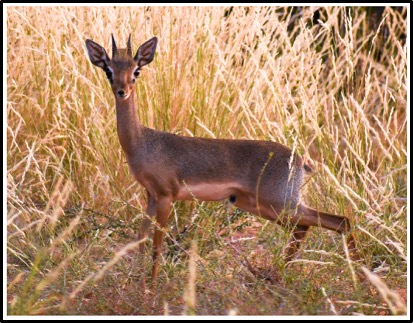
A similar and even more dramatic scene was unfolding when the peace was broken by a busload of international students. Within seconds, they were scrambling for their phones, buzzing with excitement. The star of the show? A pair of dik-diks resting under a nearby tree. If you haven’t seen one, a dik-dik is essentially the world’s most fragile antelope. They are tiny, big-eyed, and monogamous, and because nearly every predator in Africa wants to eat them, they are biologically wired to be terrified of everything.
Yet, these dik-diks didn’t flee. As students crowded around for selfies, they simply stepped a few feet to the side and went back to resting. Had they become “civilized?” Watching this unfold, I understood that it must have resulted from a slow process that had gone on long enough to make them tolerant of humans.
A question began to nag at me: Are we accidentally “un-wilding” the wild?
In ecology, tolerance allows animals to exploit the safety of humans (especially where humans don’t kill animals by hunting or poaching) through what we call the “Human Shield Effect,” another invisible boundary. Because apex predators like lions and hyenas usually avoid people, animals like dik-diks have realized that staying near us acts as a suit of armor. But that armor comes with a psychological price. Think of it like growing up in a perfectly safe, quiet suburb. You never learn to lock your doors or look over your shoulder. If you suddenly move to a busy, unpredictable city, your lack of “street smarts” makes you an easy target. By acting as a shield, we are effectively dulling the very instincts these animals need to survive.
To see how deep this went, my team and I designed a “scare test.” We played recordings of hyena calls to different groups of dik-diks. The wild ones in the bush went into an immediate panic, often fleeing. But the “suburban” dik-diks near the research center? They barely looked up. They had become so comfortable in our bubble that they no longer recognized the sound of their own nightmare. The most fascinating part, however, was that they did still react to the alarm calls of sparrow-weaver birds which represented the presence of predators. They knew that while humans might keep the hyenas at bay, we couldn’t stop a hawk from dropping out of the sky. They were selective about their safety, but that selectivity is a deadly gamble.
I wondered if this gamble was exactly what played out when African wild dogs suddenly returned after locally disappearing for over two decades. Perhaps drawn by the high numbers of dik-diks, the wild dogs swept through them until you could hardly see any left. Had the danger of our “shield” finally become real? These predators didn’t care about our boundaries. They tore right through the area, and the dik-diks that had lost their “edge,” perhaps because they were unfamiliar with the threat of wild dogs, were the first to go. They simply weren’t prepared for a threat brave enough to breach the human bubble.
It is a sobering thought to carry with you. Next time you see a “cuddle-worthy” animal in the wild and feel the urge to get close or offer food, remember that our presence is a powerful, transformative force. We aren’t just observers; we are a shield that can accidentally hit the “mute” button on an animal’s survival.
Sometimes, the truest way to love the wild is to stay a stranger to it.
